

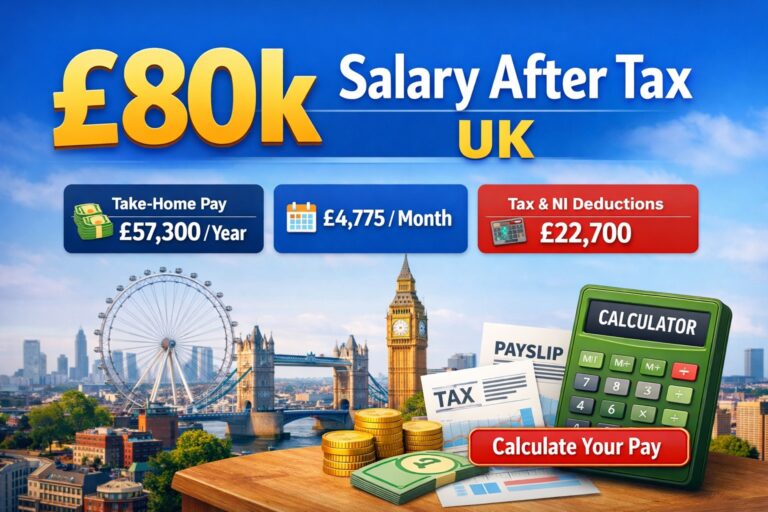
Earning £80,000 a year puts you well above the UK average salary, but many people are surprised by how much of that figure disappears once tax and National Insurance are deducted. If you are offered a job paying £80k, negotiating a raise, or simply planning your finances, understanding what £80,000 after tax looks like in real life is essential.
This guide explains how tax works on an £80,000 salary in plain English, how much you can expect to take home, and what you can do to keep more of your money legally.
Is £80,000 a Gross or Net Salary?
When people talk about an “£80k salary,” they almost always mean gross pay. This is your total salary before any deductions are made. Your take-home pay, also known as net income, is what actually lands in your bank account after income tax and National Insurance have been taken off by your employer.
Your final take-home figure depends on several assumptions. In this article, we assume you are an employee, paid through PAYE, using a standard tax code, with no pension salary sacrifice or other deductions. The figures apply to most people living in England or Wales.
How Tax Works on an £80,000 Salary in the UK
The UK uses a progressive tax system. This means you do not pay the same tax rate on your entire salary. Instead, different portions of your income are taxed at different rates.
One important thing to understand is the personal allowance. Normally, you can earn up to £12,570 tax-free. However, once your income goes above £60,000, this allowance starts to reduce. For every £2 you earn over £60,000, you lose £1 of your tax-free allowance. By the time you reach £80,000, a large portion of your allowance has been removed, which is why tax feels much heavier at this level.
On top of income tax, you also pay National Insurance contributions. While NIC rates drop slightly after a certain point, they still take a noticeable chunk from your salary.
£80,000 Salary After Tax: The Breakdown
On an £80,000 annual salary, income tax makes up the biggest deduction. You pay basic rate tax on part of your income and higher rate tax on earnings above the basic threshold. Because your personal allowance is reduced, more of your income is taxed than you might expect.
National Insurance is calculated separately. Even though the rate is lower for higher earners, it still adds up over the year.
When income tax and National Insurance are combined, total deductions on an £80k salary are significant. After everything is taken into account, your net income usually ends up in the region of the mid-£50,000s per year.
£80k After Tax: What You Take Home
Once deductions are made, an £80,000 salary typically results in a take-home pay of around £55,000 to £57,000 per year, depending on your exact tax code and circumstances.
Broken down further, this works out to roughly £4,600 to £4,800 per month. On a weekly basis, you are looking at just over £1,050. This is the money you actually have available for rent or mortgage payments, bills, food, travel, savings, and leisure.
Seeing your pay monthly rather than annually often makes it easier to understand how affordable your lifestyle will be.
£80,000 After Tax UK Calculator
£80,000 After Tax in the UK – Take-Home Pay Calculator
This calculator shows your estimated take-home pay on a £80,000 salary based on UK tax rules. Adjust the options to see how your net pay changes.
Your £80,000 Take-Home Pay
| Gross Salary | £80,000 |
|---|---|
| Income Tax | – |
| National Insurance | – |
| Net Annual Pay | – |
| Monthly Take-Home | – |
| Weekly Take-Home | – |
£80,000 After Tax in the UK: Simple Pay Breakdown Table
Assumption: PAYE employee, England/Wales, standard tax code, no pension salary sacrifice.
Annual Tax & Take-Home Summary
| Description | Amount (£) |
|---|---|
| Gross Salary | £80,000 |
| Income Tax Paid | ~£18,400 |
| National Insurance Paid | ~£4,300 |
| Total Deductions | ~£22,700 |
| Net (Take-Home) Pay per Year | ~£57,300 |
Explanation:
This table shows how much of your £80,000 salary goes to tax and National Insurance before you receive your pay. The biggest deduction comes from income tax, especially because your personal allowance is reduced at this income level.
Monthly, Weekly & Daily Take-Home Pay
| Pay Period | Take-Home Pay (£) |
|---|---|
| Monthly | ~£4,775 |
| Weekly | ~£1,102 |
| Daily (5-day week) | ~£220 |
Explanation:
Most people find monthly figures easier to work with for budgeting rent, bills, and savings. Weekly and daily figures help you visualise how much your salary is really worth in day-to-day life.
How £80,000 Is Taxed (Simplified View)
| Income Portion | Tax Rate | Why It Applies |
|---|---|---|
| First part of income | 0% | Reduced personal allowance |
| Basic rate portion | 20% | Standard UK income tax |
| Higher rate portion | 40% | Income above basic threshold |
| National Insurance | 2%–8% | Employee NIC contributions |
Explanation:
Not all of your income is taxed at 40%. Only the part above the higher-rate threshold is. However, losing your personal allowance makes the effective tax feel much higher.
Does Location in the UK Affect £80k After Tax?
Where you live in the UK can make a difference. In England and Wales, tax rates are the same, so take-home pay is broadly identical.
Scotland, however, has its own income tax bands. Higher earners in Scotland often pay slightly more tax than those elsewhere in the UK. If you live and work in Scotland, your take-home pay on £80,000 may be a little lower than in England.
Is £80k a Comfortable Salary in the UK?
For most people, £80,000 is a very comfortable salary. Outside of London, this income can support a high standard of living, allow regular savings, and still leave room for holidays and discretionary spending.
In London and the South East, the picture changes slightly. High housing costs, childcare expenses, and commuting can quickly eat into your take-home pay. While £80k is still a strong income, it may feel less luxurious in areas with a high cost of living.
The key point is that lifestyle inflation can creep in quickly at this level, so budgeting still matters.
£80k Compared to Other Salaries
One thing many people notice is that the jump from £70,000 to £80,000 does not feel as big as expected. This is because the loss of the personal allowance and higher tax rates reduce how much of that extra income you actually keep.
Similarly, moving beyond £80k towards £90k or £100k can result in diminishing returns unless you plan your tax carefully. This is why many higher earners focus on tax efficiency rather than just salary increases.
How to Increase Take-Home Pay on an £80k Salary
There are legal ways to reduce your tax bill and increase your take-home pay. Pension contributions are one of the most effective options. By contributing more into a pension, especially through salary sacrifice, you can reduce taxable income and regain some of the lost personal allowance.
Other options include tax-efficient workplace benefits, charitable donations through Gift Aid, and making sure your tax code is correct. For couples, certain allowances may also help in specific situations.
If your income varies or you receive bonuses, planning ahead can make a big difference.
What If You Are Self-Employed or a Contractor?
If you earn £80,000 as a contractor or self-employed individual, your take-home pay can be very different. Expenses, pension planning, and how you structure your income all affect how much tax you pay.
Contractors operating through limited companies may choose a mix of salary and dividends, which can be more tax-efficient than PAYE employment. However, the rules are complex, and professional advice is usually worthwhile at this income level.
Need a More Accurate £80k After Tax Calculation?
While guides like this give a strong estimate, your actual take-home pay on an £80,000 salary can vary depending on pension contributions, bonuses, tax codes, and where you live in the UK. For a more detailed and up-to-date breakdown, online accountants like TaxPound can be especially helpful.
TaxPound focuses specifically on UK salary and tax calculations, making it easier to understand how income tax, National Insurance, and allowances affect your pay. It’s particularly useful if you want to compare different salary levels, check monthly take-home pay, or see how changes like pension contributions impact your net income.
Final Thoughts on £80,000 After Tax in the UK
An £80,000 salary places you among the UK’s higher earners, but tax plays a major role in shaping what you actually take home. Once income tax and National Insurance are deducted, your real spending power is closer to the mid-£50,000s.
Understanding how the personal allowance reduction works and planning your finances carefully can help you make the most of your income. Whether you are employed or self-employed, knowing what £80k after tax really means allows you to budget confidently and avoid unpleasant surprises on payday.
Related:
£50,000 After Tax in the UK: What Your Salary Really Looks Like
£35,000 After Tax in the UK: What Your Salary Really Looks Like