

Running a limited company in the UK comes with a raft of financial responsibilities, and for most directors, an accountant becomes an essential partner in managing them. A limited company accountant handles everything from preparing your annual accounts to filing your corporation tax return, ensuring you stay compliant with HMRC and Companies House.
Understanding what you’re paying for—and why—is crucial. Many business owners feel confused by varying fee structures, unsure whether they’re getting good value or paying over the odds. Some accountants charge monthly retainers, others bill by the hour, and the services included can differ wildly from one firm to the next.
This guide breaks down everything you need to know about limited company accountant fees in the UK, helping you make an informed choice without overpaying or underselling your business’s needs.
What Are Limited Company Accountant Fees?

Accountant fees are the charges you pay a qualified professional or firm to manage your company’s financial records, tax obligations, and regulatory compliance. These fees cover the accountant’s time, expertise, and the software or resources they use to keep your business compliant.
You’ll typically encounter two main pricing models: one-off fees for specific tasks like filing your annual accounts, or monthly packages that bundle several services together. Monthly packages are increasingly popular because they spread the cost evenly and often include ongoing support like bookkeeping or VAT returns.
Fixed fees mean you pay a set amount regardless of how long the work takes, whilst hourly rates fluctuate depending on the time spent. Fixed fees offer predictability, which many limited company directors prefer when budgeting.
Average Accountant Fees for Limited Companies in the UK
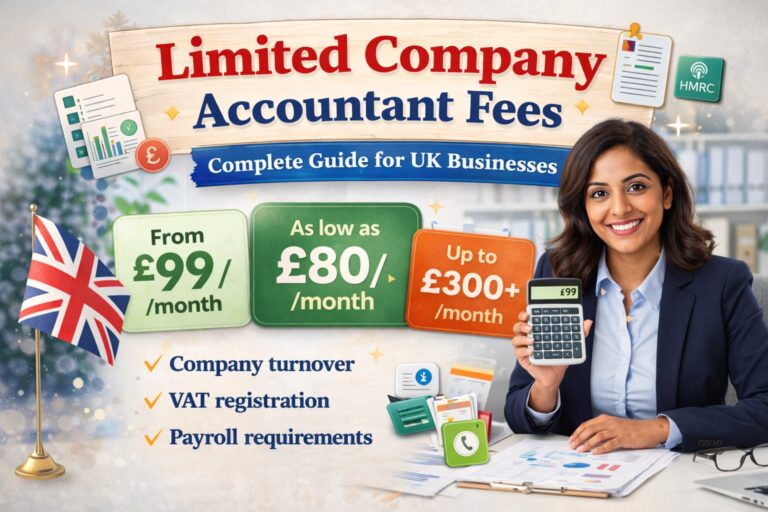
Most limited companies in the UK can expect to pay between £80 and £300 per month for accountancy services, though this can rise significantly for larger or more complex businesses. On an annual basis, that works out to roughly £960 to £3,600, excluding any additional services.
Micro-entities and newly formed companies with minimal transactions often sit at the lower end of this range. If your turnover is under £100,000 and you have straightforward income and expenses, you might pay closer to £80 to £120 per month.
Growing companies with higher turnover, multiple employees, or VAT registration requirements typically pay £150 to £300 or more. The more complex your financial situation, the higher the fees, as accountants need more time to manage your records and ensure compliance.
Factors That Affect Limited Company Accountant Fees
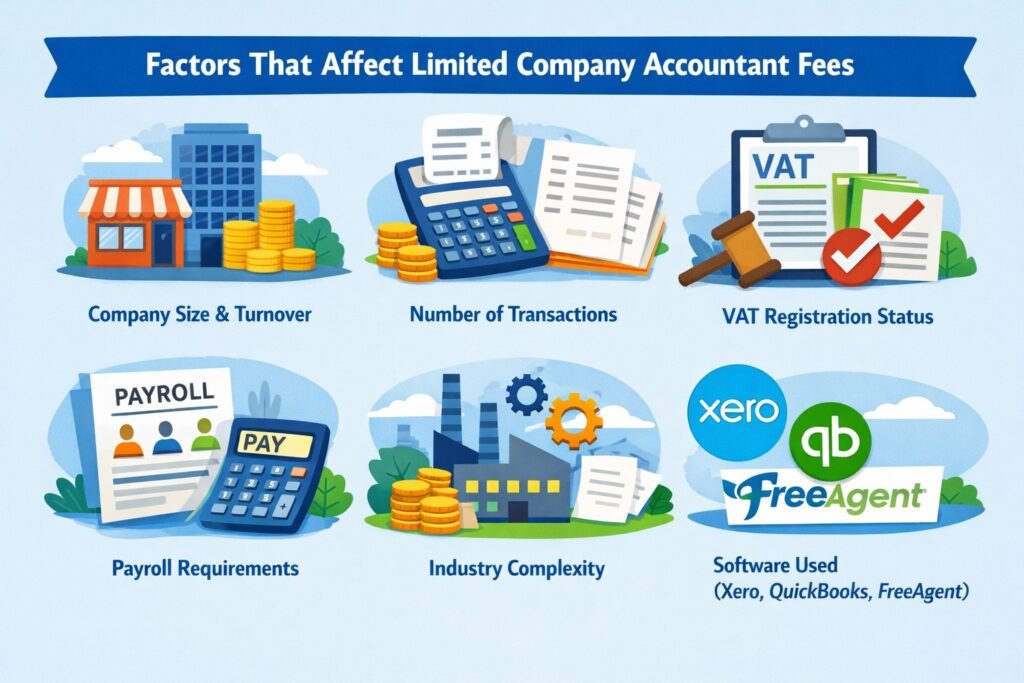
Understanding why accountant fees vary so much between businesses is essential for budgeting accurately and choosing the right service. Several key factors influence what you’ll pay, and being aware of these can help you negotiate better rates or understand why your quote might be higher than a fellow director’s.
Company Size and Annual Turnover
Your company’s turnover is one of the most significant determinants of accountant fees. A business with £50,000 in annual revenue will typically pay far less than one turning over £500,000, even if both have similar structures.
This is because higher turnover usually correlates with greater responsibility for the accountant. HMRC scrutinises larger companies more closely, and the financial statements require more detailed preparation and analysis. Additionally, companies approaching or exceeding certain thresholds—such as £85,000 for VAT registration or £10.2 million for audit requirements—face additional compliance obligations that increase the workload.
Micro-entities, defined as companies with turnover under £632,000, typically benefit from simplified accounting requirements and therefore lower fees. Once you exceed these thresholds, your accountant must prepare more detailed statutory accounts, which takes additional time and expertise.
Number and Volume of Transactions
The sheer volume of transactions your business processes each month has a direct impact on accountancy costs. A consultant who invoices five clients per month and has ten expense receipts will require minimal bookkeeping support compared to an e-commerce retailer processing hundreds of sales and purchases daily.
Each transaction needs to be recorded, categorised, and reconciled against bank statements. More transactions mean more data entry, more potential for errors, and more time spent ensuring everything balances correctly. If you’re issuing dozens of invoices, managing multiple suppliers, and handling frequent expenses, expect your accountant to charge accordingly.
Some accountants structure their fees based on transaction volumes, with tiered pricing that increases as you cross certain thresholds—for example, up to 50 transactions per month at one rate, 51-150 at another, and so on. Others absorb a reasonable number of transactions within their standard fee but charge extra once you exceed agreed limits.
VAT Registration Status
VAT registration adds a significant layer of complexity to your accounting requirements and almost always increases your accountant’s fees. Once registered, you must file VAT returns quarterly (or monthly for some schemes), which requires detailed tracking of all sales and purchases, calculating the VAT due, and ensuring timely submission to HMRC.
Your accountant needs to understand which supplies are standard-rated, zero-rated, or exempt, and must ensure your invoices are VAT-compliant. They’ll also need to reconcile your VAT returns with your accounts and help you manage cash flow around VAT payment deadlines.
Most accountants charge an additional £20 to £60 per month for VAT services, though this can be higher for businesses with complex VAT situations, such as those dealing with international sales, partial exemption, or the Tour Operators Margin Scheme. The Flat Rate Scheme can sometimes reduce accounting costs slightly, as it simplifies calculations, but you’ll still pay more than a non-VAT registered business.
If you’re approaching the £90,000 VAT registration threshold (as of April 2024), it’s worth factoring in these additional costs when planning your budget.
Payroll Requirements
Running payroll adds another dimension to your accounting needs and typically increases monthly fees substantially. If you employ staff—or even just pay yourself a salary as a director—your accountant must process payroll, calculate PAYE and National Insurance contributions, file Real Time Information (RTI) submissions to HMRC, and handle pension auto-enrolment.
The cost varies depending on how many employees you have. Processing payroll for one director might add £10 to £30 per month to your accountant’s fee, whilst a business with five to ten employees could see an additional £50 to £150 per month. Larger payrolls with complex requirements—such as different pay rates, statutory payments (sick pay, maternity pay), or numerous joiners and leavers—cost even more.
Some accountants include basic payroll for one or two directors in their standard packages, whilst others charge separately for any payroll work. Seasonal businesses with fluctuating staff numbers may face variable costs, as accountants often charge per payslip processed.
Pension auto-enrolment compliance is particularly time-consuming, requiring your accountant to manage employee opt-ins, calculate contributions, and submit data to your pension provider. This additional administrative burden is reflected in higher fees.
Industry Complexity and Sector-Specific Requirements
Not all industries are created equal when it comes to accounting complexity. Certain sectors have unique regulations, tax treatments, or reporting requirements that demand specialist knowledge and increase accountant fees accordingly.
Construction companies, for example, often fall under the Construction Industry Scheme (CIS), which requires monthly returns showing payments to subcontractors and deductions made. This adds extra administration and typically costs an additional £30 to £80 per month. Accountants handling CIS work need to understand verification procedures, gross payment status, and the interaction between CIS and VAT.
Businesses claiming Research and Development (R&D) tax credits—common in tech, engineering, and pharmaceutical sectors—require accountants with specialist expertise. Preparing R&D claims involves detailed technical reports, cost analysis, and liaison with HMRC, which can add anywhere from £500 to several thousand pounds to your annual fees, often charged as a percentage of the claim value.
E-commerce businesses, particularly those selling internationally, face complex VAT rules around cross-border transactions, distance selling thresholds, and import VAT. Property developers and landlords deal with intricate capital allowances, stamp duty considerations, and rental income reporting. Medical professionals, legal practitioners, and financial services firms all operate under specific regulatory frameworks that require accountants with sector experience.
If your industry has unique characteristics, expect to pay a premium for an accountant who genuinely understands it. Generic accountants may charge less initially but can miss valuable reliefs or make costly errors.
Cloud Accounting Software and Integration
The accounting software your business uses—or doesn’t use—significantly affects your accountant’s fees. Most modern accountants prefer cloud-based platforms like Xero, QuickBooks, or FreeAgent because they allow real-time access to your financial data, automate bank reconciliations, and streamline workflows.
If you’re already using one of these systems and keeping it reasonably up to date, your accountant can work much more efficiently, which usually translates to lower fees. Many accountants offer discounts—sometimes £20 to £50 per month—to clients who use their preferred software and maintain good records.
Conversely, if you’re using spreadsheets, manual ledgers, or incompatible software, your accountant will need to spend additional time transferring data, which increases costs. Some accountants charge extra for “bookkeeping catch-up” if you arrive at year-end with months of unrecorded transactions.
Certain software integrations can add value. For example, connecting your Xero account to your bank, payment processors like Stripe or PayPal, and e-commerce platforms like Shopify can automate much of your bookkeeping services. If your accountant needs to manually input data because systems don’t integrate, expect higher fees.
It’s worth noting that whilst accounting software itself costs £10 to £40 per month, it often pays for itself by reducing your accountant’s fees. Many accountants also offer discounted software subscriptions as part of their packages.
Geographic Location and Accountant Type
Where your accountant is based can influence their fees, though this matters less in the age of online accounting. Traditional high-street firms in London or other expensive city centres typically charge more due to higher overheads—office rent, rates, and staff costs in central locations are substantially higher than in smaller towns or rural areas.
A London-based traditional accountancy firm might charge £250 to £500 per month for services that a regional firm offers for £150 to £250. However, location is becoming less relevant as more businesses use online accountants who operate with minimal physical infrastructure and can therefore offer competitive rates regardless of where you’re based.
The type of accountant you choose also affects pricing. Large multinational firms like the “Big Four” (Deloitte, PwC, EY, KPMG) charge premium rates but are generally overkill for small limited companies. Mid-tier firms offer expertise at more reasonable prices, whilst small high-street practices and online accountants are usually the most cost-effective for SMEs.
Sole practitioner accountants often charge less than larger firms but may have capacity constraints or lack specialist knowledge in certain areas. The trade-off is typically between personalised service and scalability.
Level of Support and Advisory Services
Basic compliance work—filing accounts and tax returns—represents the minimum service level, but many businesses need more. The extent of support and advice you require will significantly impact your fees.
If you only want your accountant to handle year-end accounts and statutory filings, you’ll pay less than someone who expects regular tax planning advice, management accounts, cash flow forecasting, and strategic business guidance. Some businesses need proactive support—an accountant who spots opportunities to save tax, advises on director’s remuneration strategies, or helps with business expansion planning.
Unlimited phone and email support typically costs more than packages with restricted contact hours. Some accountants include ad-hoc queries in their standard fee, whilst others charge for anything beyond basic compliance work. Management accounts—monthly or quarterly reports showing your business’s financial performance—usually add £50 to £150+ per month to your bill.
If you’re planning significant business changes—such as taking on investors, applying for finance, acquiring another company, or restructuring—you’ll need advisory services that go beyond routine compliance, and these command additional fees.
Company Structure and Complexity
The structure of your limited company matters more than many directors realise. A straightforward single-director company with one stream of income is the simplest scenario and attracts the lowest fees. Add multiple directors, shareholders, or complex share structures, and costs rise.
Companies with several directors often require multiple self-assessment tax returns, each potentially adding £100 to £200 to annual costs. Shareholder agreements, dividend distributions to multiple parties, and different classes of shares all increase administrative complexity.
Group structures—where you have a holding company with subsidiaries—require consolidated accounts and more sophisticated tax planning, significantly increasing fees. Similarly, if your company has overseas operations, foreign income, or international tax obligations, you’ll need specialist advice that costs considerably more.
Dormant companies or those with minimal activity pay the least, often just £300 to £600 annually for basic filing requirements. Active trading companies with growing complexity will always pay more, reflecting the increased responsibility and expertise required.
Compliance History and Record-Keeping
Your own habits and organisational skills directly impact what you’ll pay. If you’re disciplined about keeping records, categorising expenses as you go, and maintaining an up-to-date accounting system, your accountant can work efficiently and may charge less.
On the other hand, if you arrive each year with carrier bags full of unsorted receipts, incomplete bank statements, and no clear record of what various transactions relate to, your accountant will spend hours untangling the mess. Many accountants charge extra for “bookkeeping remediation” or “catch-up work,” which can add hundreds of pounds to your bill.
A history of late filings, HMRC penalties, or compliance issues will also concern accountants, as they’ll need to invest more time ensuring everything is correct going forward. Some accountants may even decline to take on clients with poor compliance records, viewing them as high-risk.
Regular communication with your accountant throughout the year, rather than radio silence until deadline panic sets in, also helps keep costs down. Accountants can work more efficiently when they’re not constantly chasing you for information or dealing with last-minute crises.
Additional Services and Add-Ons
Beyond core accounting services, there’s a long list of potential add-ons that can increase your fees. Company secretarial services—maintaining statutory registers, filing confirmation statements, managing share transfers—may cost an extra £50 to £150 per year.
Tax investigation insurance, which some accountants include or offer as an option, typically adds £10 to £30 per month but provides valuable protection if HMRC opens an enquiry. Business insurance reviews, financial planning, or help securing funding are other services that command additional fees.
If you need help with business planning, preparing investor-ready financial projections, or applying for grants and government schemes, expect to pay for these project-based services separately. Attending meetings with banks, investors, or HMRC on your behalf will usually be charged either hourly or as a fixed project fee.
Understanding which services you genuinely need—and which are nice-to-have but not essential—helps you control costs whilst still getting appropriate support for your business.What’s Usually Included in Accountant Fees?
Most standard accountancy packages for limited companies include preparation of your statutory accounts and the filing of your corporation tax return (CT600) with HMRC. These are legal requirements, so they form the backbone of any accountant’s service.
Many packages also cover the director’s self-assessment tax return, which is essential if you take dividends or a salary from your company. Bookkeeping support is often included at a basic level, though more comprehensive bookkeeping usually costs extra.
If you run payroll, some accountants include this in their monthly fee, handling PAYE, National Insurance, and pension auto-enrolment submissions. VAT-registered businesses can expect VAT return preparation and filing to be part of the package, though this is sometimes charged separately.
Crucially, a good accountant helps you stay on top of HMRC deadlines and compliance obligations, reducing the risk of penalties. They should also be available to answer general tax and accounting questions throughout the year.
Additional or Hidden Costs to Watch Out For
Whilst many services are bundled into monthly packages, there are often additional costs that catch business owners off guard. If your company has multiple directors, you might be charged extra for each additional self-assessment tax return.
HMRC enquiries or VAT inspections can trigger significant extra fees, as these require detailed preparation and liaison with the tax authorities. Company formations and dissolutions are usually charged separately, ranging from £50 to several hundred pounds depending on complexity.
If you’re claiming Research and Development (R&D) tax credits, expect to pay an additional fee—often a percentage of the claim or a fixed fee—since these claims require specialist knowledge and detailed submissions. Construction firms using the CIS scheme may also face extra charges for monthly CIS returns.
Always clarify upfront what’s included in your package and what counts as an “extra” to avoid nasty surprises when the invoice arrives.
Online vs Traditional Accountants: Fee Comparison
Online accountants have grown in popularity over the past decade, and they’re often significantly cheaper than traditional high-street firms. This is largely because they operate with lower overheads—no expensive office rent, smaller teams, and streamlined processes using cloud-based software.
A traditional accountant might charge £200 to £400 per month for services that an online firm offers for £80 to £150. Online accountants typically communicate via email, phone, or video call, which suits many modern business owners who prefer flexibility over face-to-face meetings.
However, traditional accountants offer a more personal touch and can be invaluable if you prefer in-person advice or have a particularly complex business structure. They may also have deeper local knowledge or industry connections.
For contractors, freelancers, and small to medium-sized enterprises (SMEs) with straightforward finances, online accountants are often the ideal choice. They’re cost-effective, efficient, and perfectly suited to the digital-first way many businesses now operate.
For example, many UK limited company directors now choose online accountants with fixed monthly pricing. Services like TaxPound typically charge from around £99 per month for simple one-director limited companies, with higher-tier plans ranging between £149 and £249 per month when VAT, payroll, or increased transaction volumes are involved. These fees usually cover statutory accounts, corporation tax returns, and director self-assessment, making costs predictable and easier to budget for compared to hourly-billed accountants.
Fixed-Fee Accountants vs Hourly Billing
Fixed-fee pricing has become the norm for limited company accountants, and it’s easy to see why. You know exactly what you’ll pay each month, making budgeting simpler and eliminating the anxiety of a ticking clock every time you phone your accountant with a question.
Under a fixed-fee model, your accountant agrees to complete a defined set of services for a set price, regardless of how long it takes them. This encourages efficiency and aligns the accountant’s interests with yours—they want to work quickly without compromising quality.
Hourly billing, by contrast, charges you for every minute your accountant spends on your affairs. Whilst this can work out cheaper for very simple companies with minimal needs, it’s unpredictable and can spiral if issues arise or if your accountant works slowly.
For most limited companies, fixed-fee models offer better value and peace of mind. They’re particularly suited to businesses with consistent, predictable accounting needs.
Are Cheap Accountant Fees Worth It?
It’s tempting to opt for the cheapest accountant you can find, especially when you’re trying to keep costs down as a new business. But rock-bottom fees can come with serious risks.
Low-cost accountants may lack qualifications, cut corners, or simply be too stretched to give your business the attention it deserves. Poor accounting can lead to missed tax reliefs, late filings, HMRC penalties, or even incorrect tax returns that trigger investigations.
You might also find that cheap packages exclude essential services, meaning you end up paying extra fees that negate any initial savings. Worse still, some budget accountants offer little to no support outside of the annual accounts, leaving you to navigate complex tax questions alone.
That’s not to say all affordable accountants are poor—many online firms offer excellent value. The key is to look beyond price and assess qualifications, reviews, and what’s actually included in the service. Quality accounting is an investment, not just a cost.
How to Reduce Limited Company Accountant Fees Legally
There are several smart ways to keep your accountant fees down without compromising on quality. Choosing the right package for your needs is a good start—don’t pay for services you don’t need, like payroll support if you’re a sole director with no employees.
Keeping your records organised can save your accountant hours of work, which translates into lower fees. Use cloud accounting software like Xero or QuickBooks to categorise transactions as you go, rather than handing over a shoebox of receipts at year-end.
Speaking of software, many accountants offer discounts if you use their preferred platform, and cloud tools often integrate seamlessly with their systems, reducing manual data entry. This efficiency can lower your monthly fee.
Finally, avoid unnecessary add-ons. If you can handle basic bookkeeping yourself or don’t need quarterly management accounts, say so. A lean, tailored package will always be cheaper than an all-singing, all-dancing service you barely use.
How to Choose the Right Accountant for Your Limited Company
Qualifications matter. Look for accountants who are members of recognised professional bodies like ACCA (Association of Chartered Certified Accountants), ICAEW (Institute of Chartered Accountants in England and Wales), or AAT (Association of Accounting Technicians). These organisations require members to meet strict standards and undertake continuous professional development.
Experience with limited companies is crucial. Not all accountants are familiar with the nuances of corporate tax, dividend taxation, or Companies House filing requirements, so choose someone who specialises in this area.
Industry expertise can be a bonus, especially if you operate in a niche sector like construction, e-commerce, or healthcare. An accountant who understands your industry can offer more tailored advice and spot opportunities you might otherwise miss.
Finally, check reviews and testimonials, and assess their support and response times. A brilliant accountant who takes a week to reply to emails is less valuable than a competent one who responds within 24 hours.
Example Pricing Packages
Many accountancy firms structure their services into tiered packages to suit different types of businesses. A starter package, aimed at new companies or sole directors with low turnover, might cost £80 to £120 per month and include statutory accounts, corporation tax returns, and one director’s self-assessment.
A growing business package, typically priced between £150 and £250 per month, might add bookkeeping support, VAT returns, and payroll for a small number of employees. This suits companies expanding beyond the micro-entity stage.
An all-inclusive package—ideal for businesses wanting comprehensive, hands-off support—could cost £250 to £400+ per month. These packages often include everything: full bookkeeping, unlimited support, management accounts, VAT, payroll, and proactive tax planning. Services like TaxPound offer tailored packages in this space, designed to give limited company directors complete peace of mind.
Frequently Asked Questions
How much does a limited company accountant cost per month?
Most limited companies pay between £80 and £300 per month, depending on turnover, complexity, and the services included. Simpler businesses sit at the lower end, whilst those with VAT, payroll, or higher transaction volumes pay more.
Do I need an accountant for a limited company?
Legally, no—you can file your own accounts and tax returns. Practically, yes. The rules are complex, mistakes are costly, and a good accountant often saves you more in tax efficiency than they cost in fees.
Are accountant fees tax-deductible?
Yes. Accountancy fees are an allowable business expense, meaning they reduce your company’s taxable profit and lower your corporation tax bill.
Can I change accountants mid-year?
Absolutely. You can switch accountants at any time, though it’s usually smoother to do so after your year-end. Your new accountant will liaise with your old one to ensure a smooth handover.
Final Thoughts
Choosing the right accountant for your limited company is one of the most important financial decisions you’ll make. Whilst fees vary widely, the key is to focus on value rather than price alone. A slightly more expensive accountant who saves you thousands in tax and keeps you out of trouble with HMRC is worth every penny.
Take time to compare services, check qualifications, and read reviews. Make sure you understand what’s included in your package and what counts as an extra cost. Ask questions upfront about pricing structures, response times, and how the accountant will support your business as it grows.
Ultimately, a good accountant isn’t just a compliance checkbox—they’re a strategic partner who helps your business thrive. Don’t rush the decision, and don’t be afraid to shop around until you find the right fit.