
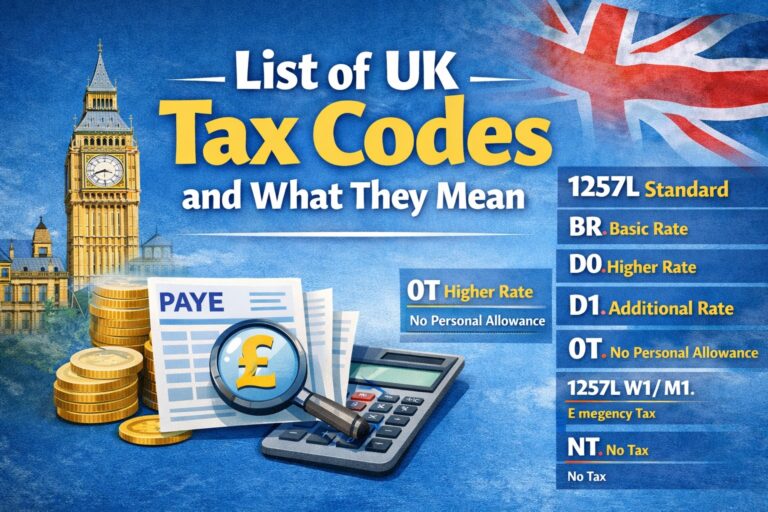
For many people in the UK, tax codes are something you notice on a payslip but rarely understand. Yet that small combination of numbers and letters plays a major role in how much tax is deducted from your wages or pension. Whether you are an employee, self-employed with PAYE income, or a pensioner, your tax code directly affects your take-home pay.
Tax codes tell your employer or pension provider how much Income Tax to deduct before you are paid. If the code is wrong, you could end up paying too much tax each month or, just as frustratingly, not enough—leading to a surprise bill later. You can usually find your tax code on your payslip, your P60, your P45 when changing jobs, or in your Personal Tax Account on the HMRC website.
Understanding what your tax code means puts you in a much better position to spot mistakes early and avoid unnecessary tax issues.
What Is a Tax Code?
A UK tax code is a set of letters and numbers issued by HMRC that instructs employers and pension providers how much tax-free income you are entitled to in a tax year. It reflects your personal allowance and any adjustments based on your circumstances.
HMRC issues tax codes based on the information they have about your income, benefits, pensions, and previous tax history. Your employer or pension provider then applies that code through the PAYE (Pay As You Earn) system to calculate how much Income Tax to deduct from each payment.
In simple terms, the tax code is HMRC’s way of making sure the right amount of tax is collected throughout the year rather than in one large payment at the end.
How to Read a UK Tax Code
Most tax codes include a number followed by one or more letters. The number usually represents how much tax-free income you are allowed to earn in the year, while the letters explain your personal situation.
For example, in the common tax code 1257L, the number 1257 means you are entitled to a personal allowance of £12,570 for the year. HMRC removes the last digit and uses the remaining number to calculate how much income is tax-free. The letter “L” indicates that you are entitled to the standard personal allowance.
Letters in tax codes provide important context. They can show whether you are on the standard allowance, paying higher rates on all income, or being taxed without any personal allowance at all. Understanding both parts together is key to knowing whether your tax code looks right.
How Much Does an Accountant Cost in the UK in 2026?
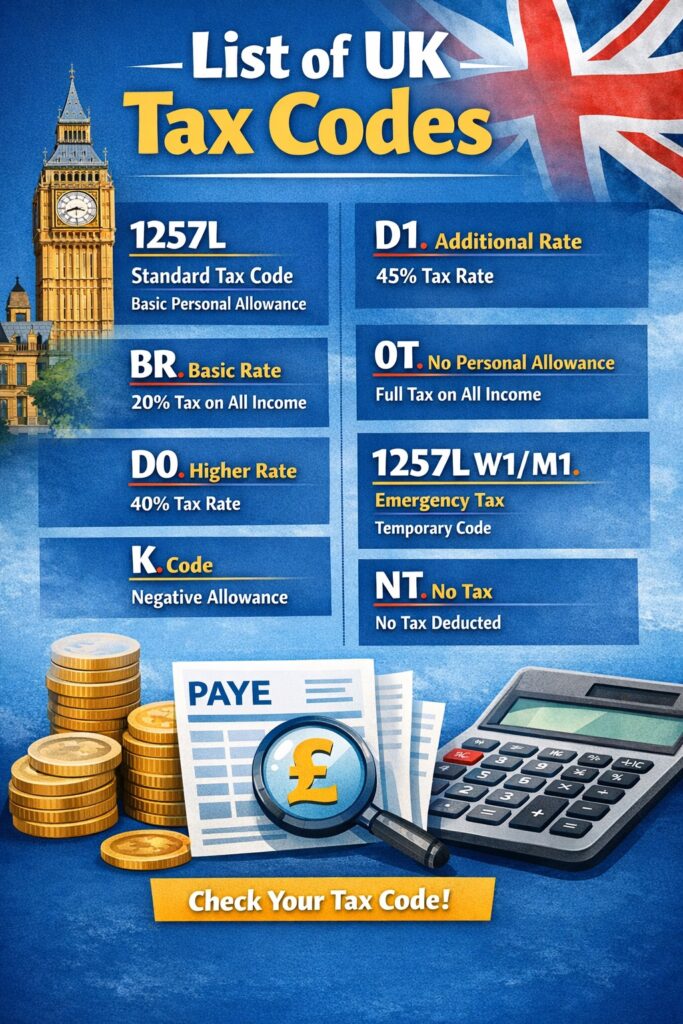
Most Common UK Tax Codes and Their Meanings
1257L (Standard Tax Code)
The 1257L tax code is the most common in the UK. It means you are entitled to the full standard personal allowance for the tax year, which is £12,570. This code is typically used by people with one job and no unusual tax adjustments.
If you see 1257L on your payslip, it usually means your tax situation is straightforward. Your employer will spread your tax-free allowance evenly across the year so you pay tax only on income above that threshold.
BR (Basic Rate)
The BR tax code means all of your income from that job or pension is taxed at the basic rate, which is currently 20%. No personal allowance is applied to that income.
BR is often used when you have a second job or an additional pension, and your personal allowance is already being used elsewhere. It can also be applied temporarily if HMRC does not have enough information about your income.
D0 Tax Code
A D0 tax code means all income is taxed at the higher rate of 40%. Like BR, it does not include any personal allowance.
This code is commonly used when someone already uses their allowance and basic rate band through another job or pension and earns additional income that falls entirely into the higher-rate tax bracket.
D1 Tax Code
The D1 tax code taxes all income at the additional rate of 45%. This applies to very high earners whose income exceeds the additional rate threshold.
D1 is usually applied to second incomes or bonuses where HMRC knows that the individual’s total income already places them in the additional rate band.
0T Tax Code
A 0T tax code means you receive no personal allowance at all. All of your income is taxed from the first pound you earn, at the relevant tax rates.
HMRC may issue a 0T code if you have used up your personal allowance elsewhere, if you start a new job without providing a P45, or if your income is high enough that your personal allowance has been reduced or removed entirely.
£35,000 After Tax in the UK: What Your Salary Really Looks Like
Emergency Tax Codes Explained
1257L W1 / M1 / X
Emergency tax codes often look like the standard code but include W1, M1, or X at the end. These mean your tax is being calculated on a weekly, monthly, or non-cumulative basis.
Emergency tax usually happens when you start a new job and HMRC does not yet have full details of your income. Under an emergency code, your employer treats each pay period in isolation, which can result in higher tax deductions.
Once HMRC receives the correct information, your tax code is usually updated, and any overpaid tax is often refunded automatically through your payslip.
Special Tax Codes You Might See
K Tax Codes (for example, K100)
A K tax code means you have a negative personal allowance. This usually happens when you owe tax from a previous year or receive taxable benefits, such as a company car, that are worth more than your personal allowance.
With a K code, your employer adds an amount to your taxable income rather than deducting an allowance. There are limits in place, however, to ensure that no more than half of your gross pay is taken in tax in any pay period.
NT (No Tax)
The NT tax code means no Income Tax is deducted from your pay or pension. This can apply in specific situations, such as when someone has very low income or is working abroad but still being paid through a UK payroll.
While NT may look appealing, it is important to be sure it is correct, as it does not necessarily mean you owe no tax at all.
Tax Codes for Pensions
Tax codes for pensions work in a similar way to employment tax codes, but they can become more complex if you receive income from multiple sources. State Pension is taxable but paid without tax deducted, so HMRC often adjusts the tax code on a private or workplace pension to collect the tax due.
If you have more than one pension, HMRC may split your personal allowance between them or apply different codes, such as BR or 0T, to secondary pensions.
Tax Codes for Multiple Jobs
If you have more than one job, HMRC usually allocates your personal allowance to your main source of income. Any additional jobs are often taxed using BR, D0, or even D1, depending on your total earnings.
If the split does not reflect your actual earnings, you can ask HMRC to adjust how your allowance is divided. This can help smooth out your tax payments and prevent large underpayments or overpayments.
Scottish and Welsh Tax Codes
Scottish Tax Codes (S Prefix)
If you live in Scotland, your tax code will usually start with an “S”. This indicates that your Income Tax rates and bands are set by the Scottish Government.
While the structure of the tax code is similar, the rates and thresholds may differ from those in the rest of the UK, which can affect how much tax you pay.
Welsh Tax Codes (C Prefix)
Welsh tax codes start with a “C”. This shows that your Income Tax is partly set by the Welsh Government.
Although Welsh rates currently match those in England and Northern Ireland, the prefix is important because it allows for future changes to be applied correctly.
Limited Company Accountant Fees: Complete Guide for UK Business Owners
What to Do If Your Tax Code Is Wrong
Signs of an incorrect tax code include sudden changes in take-home pay, paying significantly more tax than expected, or receiving a tax bill after the end of the tax year. The first step is to check your tax code through your HMRC Personal Tax Account, where you can see how it has been calculated.
If something looks wrong, you can contact HMRC directly to update your details. In more complex situations, such as multiple income sources or benefits, speaking to an accountant can help ensure everything is corrected properly and efficiently.
How Often Tax Codes Change
Tax codes are usually updated at the start of each tax year, but they can also change at any time if your circumstances change. Starting or leaving a job, receiving benefits in kind, changes in pension income, or bonuses can all trigger a review.
HMRC regularly checks tax records and may issue new codes during the year to keep your tax position as accurate as possible.
Conclusion
Understanding your UK tax code is one of the simplest ways to stay in control of your finances. A quick check can help you avoid overpaying tax and reduce the risk of unexpected bills later on. By reviewing your tax code regularly and acting quickly when something looks wrong, you can make sure you are paying exactly what you owe—no more and no less.
When your situation becomes more complex, such as having multiple jobs, pensions, or benefits, professional advice can be a valuable way to ensure everything is handled correctly.