

Understanding accountant costs is crucial for UK businesses and individuals navigating an increasingly complex financial landscape. Whether you’re a sole trader filing your first tax return, a limited company managing VAT obligations, or a freelancer concerned about IR35, knowing what to expect from accountancy fees helps you budget effectively and choose the right professional support.
In 2026, several factors are reshaping accountancy pricing across the UK. Making Tax Digital (MTD) requirements have expanded, pushing more businesses toward quarterly digital submissions for VAT and income tax. The widespread adoption of cloud accounting software like Xero, QuickBooks, and FreeAgent has streamlined bookkeeping processes, often reducing costs whilst improving accuracy. Meanwhile, the shift to remote services accelerated during the pandemic continues, with many accountants operating entirely online and passing savings on to clients.
This guide breaks down accountant costs for sole traders, limited companies, freelancers, contractors, and individuals filing personal tax returns. You’ll find typical price ranges, understand what influences fees, and learn how to get the best value from your accountant in 2026.
Quick Summary: Accountant Costs in the UK (2026)
If you’re looking for a fast answer, here are the typical cost ranges for accountancy services in the UK:
Annual costs by business type:
- Sole traders: £300–£1,200 per year for basic accounts and self assessment
- Small limited companies: £800–£2,500 per year for annual accounts and corporation tax
- Limited companies with VAT and payroll: £1,500–£4,000+ per year
Monthly packages:
- Basic sole trader support: £50–£150 per month
- Limited company packages: £100–£300+ per month
- Comprehensive services (bookkeeping, VAT, payroll): £200–£600+ per month
Individual services:
- Self assessment tax return: £150–£500
- Bookkeeping: £25–£50 per hour or £100–£400 per month
- VAT return: £50–£150 per quarter
- Payroll: £5–£15 per employee per month
These ranges vary based on your turnover, transaction volume, complexity, and whether you choose an online or traditional high-street accountant. Online accountants typically charge 20-40% less than traditional firms.
Accountant Costs by Business Type
Sole Traders
Sole traders represent the simplest business structure in the UK, and accountancy costs reflect this relative simplicity. Most sole traders pay between £300 and £1,200 annually for accountancy services, though this can vary significantly based on turnover and complexity.
What’s typically included:
- Annual self assessment tax return preparation and filing
- Basic bookkeeping review and reconciliation
- Simple profit and loss statement
- Advice on allowable expenses
- HMRC correspondence handling
Average cost ranges:
- Very small turnover (under £20,000): £300–£600 per year
- Moderate turnover (£20,000–£50,000): £500–£900 per year
- Higher turnover (£50,000–£85,000): £700–£1,200 per year
Monthly packages for sole traders typically cost £50–£150 and often include quarterly check-ins, ongoing tax advice, and unlimited email support. These packages suit traders who prefer spreading costs throughout the year rather than facing a single annual bill.
Optional extras that increase costs:
- VAT registration and quarterly returns: add £200–£600 per year
- Tax planning consultations: £100–£300 per session
- Business structure advice: £150–£500
- Detailed bookkeeping services: add £100–£400 per month
Sole traders with straightforward income and expenses at the lower end of these ranges can sometimes manage with DIY software, but most find value in professional support, particularly for maximising tax-deductible expenses and avoiding costly HMRC errors.
Limited Companies
Limited companies face more complex filing requirements than sole traders, which is reflected in higher accountancy fees. Annual costs typically range from £800 to £2,500 for basic services, with comprehensive packages reaching £4,000 or more.
Typical services included:
- Annual statutory accounts preparation
- Corporation tax return (CT600)
- Confirmation statement filing at Companies House
- Director’s self assessment tax return
- Basic tax planning and compliance advice
Cost brackets by company size:
- Micro companies (turnover under £50,000): £800–£1,500 per year
- Small companies (£50,000–£250,000): £1,200–£2,500 per year
- Growing companies (£250,000–£1 million): £2,000–£4,000+ per year
Monthly retainer packages for limited companies usually cost £100–£300 for basic services, rising to £300–£600 when including comprehensive bookkeeping, VAT, and payroll support.
Add-on services:
- VAT returns (quarterly): £200–£600 per year
- Monthly payroll processing: £50–£200+ depending on employee numbers
- Management accounts: £100–£300 per quarter
- Year-end tax planning: £200–£800
- R&D tax credit claims: typically 10-20% of the claim value
As your limited company grows, costs scale accordingly. The jump from dormant company accounts (£200–£400) to active trading can feel significant, but professional support becomes increasingly valuable as tax planning opportunities grow and compliance requirements become more demanding.
Freelancers & Contractors
Freelancers and contractors face unique considerations when it comes to accountancy costs, particularly around business structure and IR35 compliance. Many operate as sole traders initially before incorporating as limited companies once turnover justifies the additional complexity.
Sole trader freelancers: Costs mirror standard sole trader rates (£300–£1,200 annually), though freelancers with multiple income streams or complex expenses may pay toward the higher end. Contractors working through agencies often need quarterly income estimates for tax planning purposes, which some accountants include in monthly packages.
Limited company contractors: Personal service company contractors typically pay £1,200–£2,500 annually for accounts and corporation tax, with additional costs for:
- IR35 status reviews and determinations: £200–£800 per contract
- IR35 compliance support: £50–£150 per month
- Contractor-specific tax planning: £150–£500 annually
The frequency of contract changes impacts costs significantly. Contractors moving between roles every few months need regular IR35 assessments, whilst those on long-term contracts face this less frequently.
When to incorporate: Accountants often provide incorporation advice as part of their service. The general rule suggests incorporation becomes tax-efficient around £50,000–£60,000 annual profit, though individual circumstances vary. Many accountants offer fixed-fee incorporation services (£100–£300) alongside the first year’s accounting package.
Individuals (Self Assessment)
Individuals who aren’t self-employed but need to complete self assessment tax returns typically pay £150–£500, depending on complexity.
Simple returns (£150–£250):
- PAYE income only
- Basic bank interest and dividends
- Straightforward pension contributions
- No additional income sources
Moderate complexity (£250–£400):
- Rental property income
- Capital gains from investments
- Multiple PAYE sources
- Foreign income requiring double taxation relief
Complex returns (£400–£500+):
- Multiple rental properties
- Significant capital gains calculations
- Partnership income
- Trust income
- Foreign domicile considerations
For many individuals, an accountant’s value lies not just in filing accuracy but in identifying tax planning opportunities. Someone with rental income might save hundreds of pounds through proper expense claiming and capital allowances, easily justifying the accountant’s fee.
Also Read: What £35k After Tax Really Means
Accountant Fees by Service (UK Pricing Examples)
Understanding individual service costs helps you build a package that suits your needs, whether you’re outsourcing everything or handling some tasks yourself.
Bookkeeping
Bookkeeping forms the foundation of good financial management, and pricing varies considerably based on transaction volume and delivery method.
Hourly rates: Traditional hourly bookkeeping services costs £25–£50, though this model is becoming less common as cloud accounting enables more efficient fixed-fee arrangements.
Monthly packages:
- Basic (up to 50 transactions): £100–£200
- Standard (50–150 transactions): £200–£350
- Comprehensive (150+ transactions): £350–£600+
Cloud accounting software (Xero, QuickBooks, FreeAgent) has transformed bookkeeping efficiency. Many accountants now offer partially automated services where bank feeds handle routine transactions, reducing costs by 30-50% compared to manual bookkeeping whilst improving accuracy.
Some accountants include basic bookkeeping review in their annual packages, where they reconcile your records once quarterly or annually. This hybrid approach costs less than full monthly bookkeeping but requires you to maintain basic records using accounting software.
Self Assessment & Personal Tax Returns
Personal tax return preparation remains one of the most common individual accounting services. Straightforward employed income returns start around £150–£200, whilst complex situations can reach £500 or more.
Additional charges for complexity:
- Each rental property: add £50–£150
- Capital gains calculations: add £75–£200
- Partnership or trust income: add £100–£300
- Foreign income: add £100–£250
Many accountants offer fixed fees for tax return preparation, providing certainty around costs. Some include one amendment free of charge should circumstances change, whilst others charge £50–£100 for revised submissions.
The deadline-proximity pricing is common, with many accountants charging premium rates (often 20-50% more) for returns received in January close to the 31 January filing deadline. Submitting information by November or December typically secures standard rates and ensures thorough review time.
Annual Company Accounts & Corporation Tax
Limited companies must file statutory accounts at Companies House and corporation tax returns with HMRC. Most accountants bundle these together as core services.
What’s typically included:
- Full statutory accounts preparation
- Directors’ report
- Corporation tax computation
- CT600 submission to HMRC
- Accounts filing at Companies House
- Basic tax planning advice
Average cost brackets:
- Dormant companies: £200–£400
- Micro entities (turnover under £50,000): £600–£1,200
- Small companies (£50,000–£250,000): £1,000–£2,000
- Medium companies (£250,000–£1 million): £1,800–£3,500+
Companies with more complex affairs face higher costs. Multiple revenue streams, stock valuation, work-in-progress accounting, or international transactions all increase the work required and therefore the fees charged.
VAT Returns
VAT-registered businesses must submit returns to HMRC, with most filing quarterly. Making Tax Digital requirements mean digital record-keeping and submission through compatible software is now mandatory for virtually all VAT-registered businesses.
Quarterly VAT return costs:
- Basic returns (straightforward sales and purchases): £50–£100 per quarter (£200–£400 annually)
- Standard complexity: £75–£150 per quarter (£300–£600 annually)
- Complex returns (multiple rates, partial exemption): £150+ per quarter
Monthly VAT returns cost proportionally more in total, typically £40–£80 per return, as they require more frequent attention despite potentially lower transaction volumes per period.
Many accountants include VAT return preparation within monthly bookkeeping packages, as accurate bookkeeping naturally produces VAT-ready records. This bundled approach often proves more cost-effective than paying separately for each service.
Digital filing and accuracy: MTD compliance has reduced errors significantly, but accountants still provide valuable oversight by reviewing returns before submission, identifying anomalies, and ensuring the correct VAT treatment for borderline transactions.
Payroll Services
Payroll processing costs typically run £5–£15 per employee per month, with minimum monthly fees of £50–£100 regardless of employee numbers.
Standard payroll services include:
- Monthly or weekly payslip generation
- PAYE and National Insurance calculations
- Real Time Information (RTI) submissions to HMRC
- P60 year-end certificates
- Pension auto-enrolment administration
Additional charges:
- Starter and leaver processing: £15–£40 per person
- P11D benefits reporting: £30–£75 per employee
- CIS (Construction Industry Scheme) processing: add 20-40% to standard payroll costs
- Employment Allowance claims: usually included
- Pension scheme liaison: £10–£30 per month
Director-only companies often receive discounted payroll rates (£50–£100 annually) as the processing requirements are minimal, particularly when directors take low salaries combined with dividends for tax efficiency.
Advisory & Tax Planning
Proactive tax planning can generate savings far exceeding advisory costs, making this one of the highest-value accounting services available.
Pricing structures:
- One-off tax planning session: £150–£500
- Annual tax planning review: £300–£800
- Monthly advisory retainer: £100–£500+
- Project-based work (business structure, succession planning): £500–£3,000+
In 2026, tax planning has become increasingly important as dividend tax rates, corporation tax, and personal allowance thresholds continue evolving. An accountant who proactively suggests salary-dividend optimization, pension contributions, or capital allowances claims can easily save clients thousands of pounds annually.
High-value planning areas:
- Salary and dividend optimization for directors
- Pension contribution planning for tax relief
- Capital allowances on business assets
- Incorporation timing and structure
- Extraction planning before retirement
- Inheritance tax mitigation for business owners
Many successful business owners view their accountant as a strategic partner rather than just a compliance service provider. For these relationships, monthly retainers ensure ongoing access to advice and regular reviews of financial strategy as circumstances change.
Also Read: What Are Limited Company Accountant Fees?
Online vs Traditional Accountants in the UK
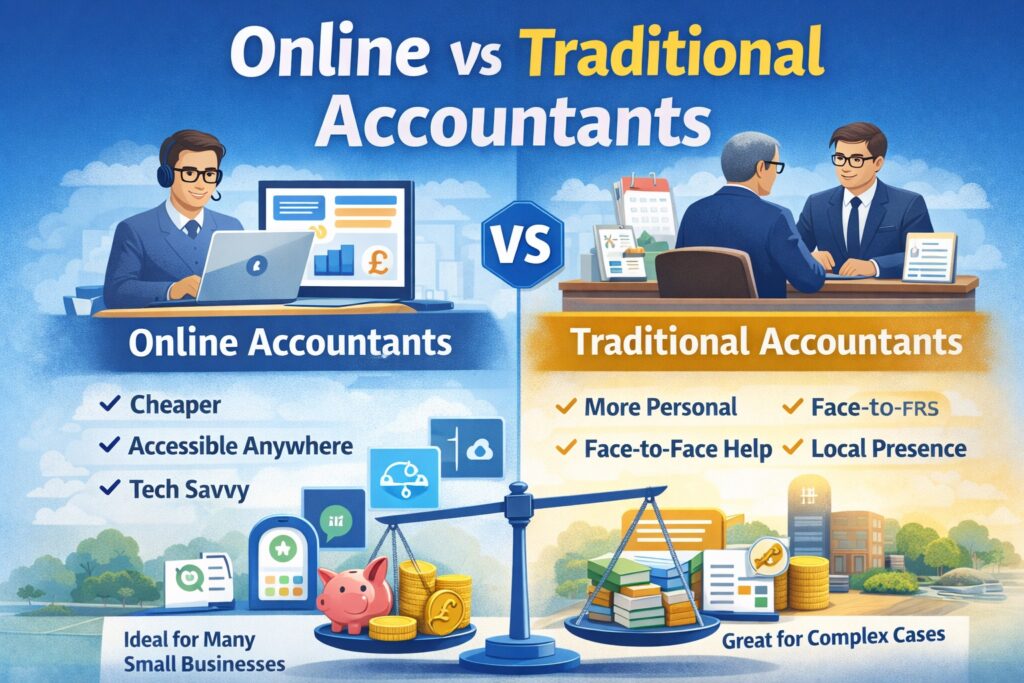
The choice between online and traditional high-street accountants significantly impacts costs, service delivery, and client experience.
Online accountants like Taxpound operate entirely remotely, using cloud-based tools for communication and document sharing. They typically charge 20-40% less than traditional firms due to lower overheads.
Typical online accountant costs:
- Sole trader: £200–£800 annually
- Limited company: £600–£1,800 annually
- Comprehensive packages with bookkeeping: £100–£400 monthly
Traditional accountants maintain physical offices and offer face-to-face meetings, commanding higher fees.
Typical traditional accountant costs:
- Sole trader: £400–£1,200 annually
- Limited company: £1,000–£2,500+ annually
- Hourly consultations: £100–£250 per hour
Which UK businesses benefit from online services:
Online accountants suit businesses and individuals who are comfortable with digital communication and cloud accounting software. They work particularly well for:
- Tech-savvy sole traders and freelancers
- Small limited companies with straightforward affairs
- Businesses already using cloud accounting software
- Clients who value cost efficiency and quick email responses
- Those who don’t require regular face-to-face meetings
Many online accounting firms provide excellent service through video calls, screen sharing, and responsive support channels. The lack of physical meetings doesn’t necessarily mean impersonal service, particularly with firms that prioritize communication quality.
When traditional face-to-face support justifies higher costs:
Some businesses and individuals genuinely benefit from traditional accountancy relationships:
- Complex business structures requiring detailed discussion
- Clients who prefer in-person relationship building
- Businesses requiring regular strategic planning sessions
- Those less comfortable with technology
- Companies in traditional industries where personal relationships matter
- High-net-worth individuals with complex tax affairs
Examples in practice:
A freelance graphic designer using FreeAgent software might thrive with an online accountant charging £60 monthly for bookkeeping review, VAT returns, and unlimited email support. The designer communicates primarily by email, rarely needs meetings, and appreciates the cost efficiency.
Conversely, a family-owned manufacturing business with £2 million turnover, fifteen employees, and complex supply chain financing might prefer a boutique high-street firm. Despite paying £5,000+ annually, they value quarterly face-to-face meetings for management accounts review and strategic planning.
Neither approach is inherently better. The right choice depends on your communication preferences, business complexity, and whether the cost difference represents genuine value or simply pays for services you won’t use.
Key Factors That Affect Accountant Pricing in the UK
Understanding pricing drivers helps you anticipate costs and potentially reduce them through preparation or business structure decisions.
Turnover and transaction volume: Higher revenue doesn’t always mean proportionally higher fees, but it typically indicates more transactions, greater complexity, and more time required for accounts preparation. A company with £100,000 turnover from five large contracts needs less work than one with the same turnover from 500 small sales.
VAT registration: VAT registration adds £200–£600 annually to accountancy costs. The additional work includes quarterly return preparation, MTD compliance, and oversight of VAT treatment for transactions. However, VAT registration also brings benefits (reclaiming input VAT) that often outweigh the additional professional fees.
Payroll and employees: Each employee adds £5–£15 monthly to payroll costs, plus pension auto-enrolment administration. Companies with high staff turnover face additional starter and leaver processing charges. Director-only companies have minimal payroll costs, whilst those with dozens of employees might spend £2,000–£5,000 annually on payroll alone.
Industry-specific requirements: Certain industries carry additional compliance or complexity:
- Construction (CIS deductions and reverse charge VAT)
- Restaurants and hospitality (tips, tronc schemes, high transaction volumes)
- E-commerce (multi-channel sales, stock management, Amazon accounting)
- Property investment (multiple properties, complex expense allocation)
- Healthcare professionals (NHS pension scheme, complex income sources)
Accountants familiar with your industry’s specific requirements provide better service and often identify tax savings others might miss, justifying any premium fees.
Frequency of reporting: Businesses requiring monthly management accounts, frequent VAT returns, or weekly payroll pay more than those with annual accounts and quarterly VAT. However, frequent reporting often provides better financial oversight, helping prevent problems before they become expensive.
Quality of records provided: Well-organized records reduce accountant time and therefore costs. Businesses using cloud accounting software with regular reconciliation present less work than those arriving with carrier bags of receipts. Some accountants charge premium rates for disorganized records or offer discounts for clients who maintain excellent bookkeeping.
Typical UK Pricing Examples (2026)
Concrete examples help visualize real-world costs for different business scenarios.
Example 1: Part-Time Sole Trader
- Turnover: £18,000
- Transactions: Approximately 150 annually
- Services needed: Self assessment tax return, basic bookkeeping review
- Typical cost: £300–£500 annually
- What’s included: Annual accounts, tax return, one round of HMRC correspondence if needed
Example 2: Established Freelance Consultant
- Turnover: £65,000
- Transactions: Approximately 400 annually
- Services needed: Self assessment, bookkeeping support, tax planning
- Typical cost: £800–£1,200 annually or £80–£120 monthly
- What’s included: Quarterly bookkeeping review, annual tax return, unlimited email advice, one planning meeting
Example 3: Small Limited Company (No Employees)
- Turnover: £120,000
- Director’s salary: £12,570 plus dividends
- Services needed: Annual accounts, corporation tax, self assessment, basic payroll
- Typical cost: £1,200–£1,800 annually
- What’s included: Statutory accounts, CT600, director’s tax return, dividend vouchers, director payroll
Example 4: Limited Company with VAT
- Turnover: £180,000
- Transactions: Approximately 1,200 annually
- Services needed: Accounts, corporation tax, VAT returns, director’s tax return
- Typical cost: £1,800–£2,500 annually or £180–£250 monthly
- What’s included: All of the above plus quarterly VAT returns
Example 5: Growing Company with Payroll
- Turnover: £450,000
- Employees: 8 (plus 2 directors)
- Services needed: Full bookkeeping, accounts, VAT, payroll, management accounts
- Typical cost: £3,500–£5,500 annually or £350–£500 monthly
- What’s included: Monthly bookkeeping, quarterly management accounts, annual statutory accounts, VAT returns, full payroll service, tax planning
Example 6: Individual with Rental Income
- Employment income: £55,000 (PAYE)
- Rental properties: 2
- Services needed: Self assessment tax return with rental income
- Typical cost: £300–£450
- What’s included: Tax return preparation including rental income calculations, allowable expense advice
These examples represent typical mid-market pricing from competent accountants. Online-only providers might charge 20-30% less, whilst prestigious high-street firms could charge 30-50% more.
Are Cheaper Accountants Worth It in the UK?
The temptation of low-cost accounting services is understandable, particularly for small businesses watching every expense. However, accountancy is one area where the cheapest option can prove expensive in the long run.
Potential advantages of low-cost providers:
- Significant cost savings, particularly for straightforward affairs
- Often use efficient cloud-based systems
- Can provide perfectly adequate service for simple requirements
- May suit businesses prioritizing low cost above all else
Risks of ultra-cheap accounting services:
- Higher error rates leading to HMRC penalties and interest
- Limited availability for advice and questions
- High-volume business models with less personal attention
- Missing tax planning opportunities that would exceed the fee savings
- Potential for hidden charges when complexity arises
- Less experience with industry-specific issues
- May lack proper professional indemnity insurance
Real-world cost of errors:
Consider a sole trader who chooses a £150 annual accounting service over a £500 service, saving £350. If the cheaper accountant misses £3,000 of allowable expenses, the trader pays approximately £900 in unnecessary tax (at 30% effective rate including National Insurance). The “saving” actually costs £550.
Similarly, a limited company saving £500 by using a budget accountant might miss tax-efficient dividend timing or R&D tax credit opportunities worth thousands of pounds.
Services that should never be cut too cheaply:
Some accounting services carry higher risk and warrant paying for quality:
- Corporation tax planning and optimization
- IR35 status determinations for contractors
- Capital gains tax calculations
- Complex self assessment returns
- HMRC investigation support
- Business structure and incorporation advice
For these areas, the cost of mistakes or missed opportunities far exceeds any fee savings from budget providers.
Finding the balance:
The optimal approach isn’t necessarily the most expensive accountant. Instead, look for:
- Transparent pricing with clear service descriptions
- Relevant qualifications and experience
- Positive reviews and testimonials
- Good communication and responsiveness
- Value alignment with your needs
A mid-priced accountant who communicates well and understands your industry often provides better value than either budget or premium alternatives.
How to Save Money on Accountant Fees (UK Tips)
Reducing accountancy costs doesn’t require sacrificing quality. Several strategies help you pay less whilst maintaining excellent service.
Use cloud accounting software effectively: Modern accounting software like Xero, QuickBooks, or FreeAgent automates much of the bookkeeping process. Bank feeds automatically import and categorize transactions, reducing manual data entry. Many accountants offer reduced fees (often 20-40% less) when clients maintain good records in cloud software, as accounts preparation becomes far quicker.
Investing £10–£30 monthly in accounting software can reduce annual accountancy fees by £300–£800, creating net savings whilst improving your financial visibility throughout the year.
Prepare records before submission: Organized records save your accountant hours of work. Simple practices make a significant difference:
- Reconcile bank accounts monthly
- Keep digital copies of receipts and invoices
- Separate business and personal expenses clearly
- Document unusual transactions with explanatory notes
- Maintain an asset register for equipment purchases
- Keep employment and payroll records organized
Some accountants explicitly discount fees for well-prepared clients, whilst others simply require fewer hours. Either way, good record-keeping reduces costs.
Choose the right service bundle: Paying for only what you need prevents waste. Consider:
- Do you need monthly bookkeeping or just quarterly review?
- Is unlimited advice valuable or would you rarely use it?
- Would annual tax planning generate enough savings to justify the cost?
- Could you handle payroll yourself using software?
Conversely, some bundled packages offer better value than piecing together individual services. Many accountants discount comprehensive packages by 10-20% compared to buying services separately.
Review fees annually: Accounting relationships can drift into providing (and charging for) services you no longer need. Annual reviews ensure you’re paying for value:
- Has your business simplified, potentially needing less support?
- Are you paying for monthly bookkeeping you could now handle yourself?
- Would switching to annual billing provide a discount?
- Do competitor accountants offer better value?
Most accountants prefer retaining clients at slightly reduced fees rather than losing them to competitors. Professional, friendly fee discussions often result in adjustments, particularly for long-standing clients with straightforward affairs.
Timing of submissions: Submitting information early in the accountancy cycle often secures better rates. Tax returns provided in November rather than January, or year-end accounts submitted promptly, sometimes attract discounts as accountants appreciate work outside their peak periods.
DIY where appropriate: Some tasks suit DIY approaches, reserving professional support for complex matters:
- Basic data entry into accounting software
- Simple invoice creation
- Receipt scanning and filing
- Basic payroll for director-only companies (using HMRC tools)
This hybrid approach maintains professional oversight for important compliance and planning whilst reducing fees for routine tasks.
How to Choose the Right Accountant in the UK (2026 Checklist)
Selecting an accountant involves more than comparing prices. The right match saves money through tax efficiency whilst providing peace of mind about compliance.
Clear pricing transparency: Quality accountants provide upfront, transparent pricing. They should clearly explain:
- What’s included in quoted fees
- How additional services are charged
- Typical extra costs you might encounter
- Payment terms and frequency
- How fees might change as your business grows
Vague pricing or reluctance to provide written quotes often signals problems ahead. Fixed fees work better for most clients than hourly billing, providing cost certainty and incentivizing efficiency.
Relevant UK qualifications: Look for recognized professional qualifications demonstrating competence and ongoing education:
- ACCA (Association of Chartered Certified Accountants)
- ACA (Associate Chartered Accountant via ICAEW)
- CIMA (Chartered Institute of Management Accountants)
- ATT (Association of Taxation Technicians)
- CTA (Chartered Tax Adviser)
Qualified accountants must meet continuing professional development requirements and carry professional indemnity insurance. They’re also bound by ethical standards and face consequences for poor work, providing protection unqualified bookkeepers or accountants can’t offer.
Software compatibility: Ensure your accountant supports your preferred accounting software. Most modern accountants work with:
- Xero (very common, cloud-based)
- QuickBooks Online (popular, especially with smaller businesses)
- FreeAgent (contractor-focused)
- Sage (traditional but still widely used)
Accountants who embrace cloud software generally provide more efficient, cost-effective service than those still working primarily with spreadsheets or desktop software.
Communication expectations: Clarify communication terms before engaging:
- How quickly do they typically respond to emails?
- Are phone calls included or charged separately?
- Do you get a dedicated contact person?
- How many meetings per year are included?
- Can you contact them outside package inclusions if needed?
Mismatched communication expectations cause frustration. If you prefer weekly check-ins, a low-cost online accountant responding within 48 hours might frustrate you. Conversely, if you rarely need contact, paying premium fees for immediate access wastes money.
Industry experience: Accountants familiar with your industry provide better service. They understand sector-specific:
- Tax planning opportunities
- Allowable expense norms
- Common compliance pitfalls
- Business benchmarks and key metrics
- Industry-specific software and systems
A construction accountant immediately understands CIS deductions, whilst an e-commerce specialist knows Amazon accounting and VAT complexities. This experience often identifies savings and prevents errors worth far more than any fee premium.
Cultural fit: Beyond technical competence, consider whether you’ll enjoy working with this person:
- Do they communicate in language you understand?
- Are they proactive or purely reactive?
- Do they seem genuinely interested in your success?
- Are they judgmental about financial questions?
- Do they explain things patiently?
You’ll share financial information and potentially sensitive business challenges with your accountant. A good relationship makes this comfortable and productive.
Checking credentials: Before engaging an accountant, verify:
- Professional body membership (searchable on ACCA, ICAEW websites)
- Reviews and testimonials from existing clients
- How long they’ve been practicing
- Professional indemnity insurance coverage
- Any disciplinary history with professional bodies
Taking time to choose carefully prevents expensive mistakes later.
When You Might NOT Need an Accountant
Despite accountants providing value for most businesses and many individuals, some situations don’t justify professional fees.
Very simple sole trader returns: If you operate a very simple sole trader business with:
- Under £10,000 turnover
- Minimal expenses
- No complicating factors (other income, capital gains, etc.)
- Good record-keeping skills
- Confidence using HMRC’s online systems
You might successfully file your own self assessment return using HMRC’s free software. Many people with simple side hustles or very small businesses manage this perfectly well, saving several hundred pounds annually.
Using HMRC services: HMRC provides free guidance, webinars, and phone support for taxpayers. Their helplines can answer basic questions about:
- What expenses are allowable
- How to complete specific tax return sections
- Payment plans for tax bills
- Making Tax Digital requirements
For individuals with straightforward tax affairs and patience for government helplines, these free resources sometimes suffice.
When DIY accounting software is enough: Modern accounting software has become remarkably capable. Packages like QuickBooks, FreeAgent, or Xero include:
- Automated bank reconciliation
- Invoice and receipt management
- VAT return preparation
- Basic payroll for small numbers
- Real-time profit and loss visibility
- Guided workflows for common tasks
Some businesses use these tools independently for bookkeeping and transaction management, only engaging an accountant annually for year-end accounts and tax return preparation. This hybrid approach works well for tech-savvy business owners with relatively straightforward affairs.
The risk calculation: When considering DIY accounting, honestly assess:
- Your confidence with financial concepts and terminology
- Time available to learn accounting basics properly
- Whether you’ll actually maintain records consistently
- The cost of potential errors versus professional fees
- Your business’s complexity level
The peace of mind from professional support often justifies the cost, particularly as businesses grow. Many successful business owners view their accountant as valuable enough to retain even when they technically could manage themselves.
Final Thoughts
Accountant costs in the UK in 2026 vary significantly based on business type, complexity, and service requirements. Sole traders typically pay £300–£1,200 annually, whilst small limited companies pay £800–£2,500 or more. Adding services like VAT returns, payroll, and comprehensive bookkeeping increases costs but often provides corresponding value through time savings, compliance certainty, and tax planning opportunities.
The cheapest accountant rarely represents the best value. Errors, missed tax savings, and HMRC penalties can cost far more than any fee savings. Instead, focus on finding an accountant who provides transparent pricing, relevant qualifications, good communication, and experience with your industry and business type.
For most UK businesses and many individuals, professional accounting support more than pays for itself through tax efficiency, compliance confidence, and the time freed to focus on actually running your business or managing your career. The key is matching service level to your genuine needs, neither overpaying for unused services nor underpaying and risking costly mistakes.
Your next steps:
- Assess which services you genuinely need
- Gather quotes from 3-4 accountants with relevant experience
- Check qualifications and reviews
- Have honest conversations about pricing and expectations
- Choose based on value and fit, not just lowest cost
- Review the relationship annually to ensure continued value
Remember that changing accountants is relatively straightforward if the relationship isn’t working. Most accountants make transition smooth through professional clearance procedures. Don’t remain with an accountant providing poor service out of inertia.
Investing time in finding the right accounting support in 2026 sets the foundation for financial confidence and business success throughout the year ahead.
FAQ Section
How much should I pay an accountant for self assessment in the UK?
Expect to pay £150–£500 for personal tax return preparation, depending on complexity. Simple employed income returns cost £150–£250, whilst returns involving rental income, capital gains, or multiple income sources typically cost £250–£500. If you’re self-employed as a sole trader, annual accounting including self assessment typically runs £300–£1,200.
Do accountants file VAT for you?
Yes, most accountants include VAT return preparation and filing as part of their services. Quarterly VAT returns typically cost £200–£600 annually (£50–£150 per quarter), though this is often included in monthly bookkeeping packages. Making Tax Digital requirements mean VAT returns must be filed through compatible software, which accountants handle on your behalf.
What’s the difference between bookkeepers and accountants?
Bookkeepers maintain day-to-day financial records, recording transactions, reconciling accounts, and producing basic reports. Accountants typically hold professional qualifications and provide broader services including tax return preparation, accounts filing, tax planning advice, and strategic financial guidance. Many practices offer both services, often with bookkeepers handling routine data entry whilst qualified accountants oversee compliance and planning.
Can I change my accountant easily?
Yes, changing accountants is straightforward. You simply need to instruct your new accountant (ideally in writing), who will request professional clear