
If you have money sitting in a savings account, you might assume that the interest it earns is simply a reward for being financially responsible. What you may not realize, however, is that savings interest counts as taxable income — and depending on how much you earn, a surprisingly large slice of those returns could end up going to HMRC rather than staying in your pocket.
The issue has become more pressing in recent years. Rising interest rates have boosted the returns on cash savings accounts, meaning savers are now earning significantly more interest than they were just a few years ago. At the same time, frozen tax thresholds mean that more people are being pulled into higher tax bands without receiving a meaningful pay rise. The combined effect is that millions of savers now face a tax bill on their interest earnings that simply did not exist before.
The good news is that there is no need to accept this as inevitable. The UK tax system contains several perfectly legal, government-approved ways to reduce or eliminate tax on your savings. From Individual Savings Accounts to pension contributions, the rules are designed to reward sensible financial planning — you simply need to know how to use them.
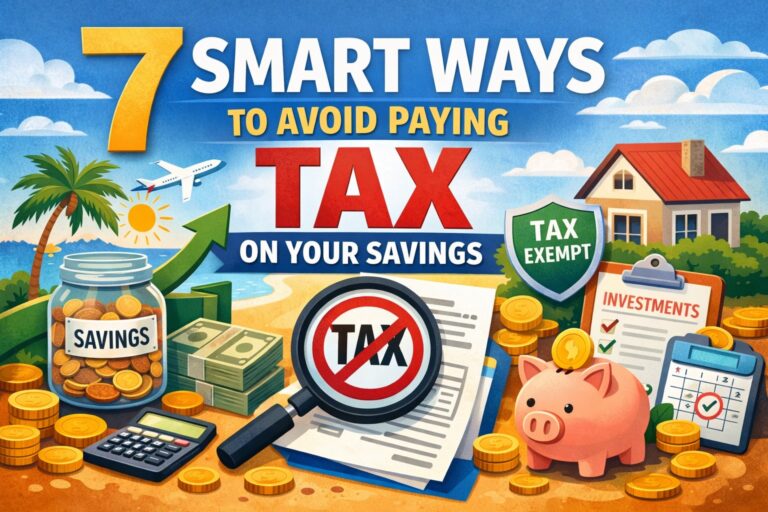
This article sets out seven of the most effective strategies. Whether you are a basic rate taxpayer with modest savings or a higher earner with a substantial nest egg, at least one of these approaches is likely to make a meaningful difference to the after-tax return on your money.
1. Use a Tax-Free Savings Account (ISA)
The Individual Savings Account, or ISA, is arguably the most well-known tax-efficient savings vehicle available to UK residents — and for good reason. Any interest earned, investment growth, or income generated inside an ISA is entirely free from UK income tax and capital gains tax, both now and in the future. There are no forms to fill in, no declarations to make to HMRC, and no annual tax calculation to perform. The money simply grows, untouched by the taxman.
Each UK adult can contribute up to £20,000 into an ISA in any given tax year. This allowance resets on 6 April every year and cannot be carried forward, so there is a genuine advantage to using your allowance as early in the tax year as possible. Once money is inside the ISA wrapper, it stays protected indefinitely — there is no limit on how large your ISA pot can grow over time.
Types of ISA
There are several varieties to consider, depending on your goals:
- Cash ISA — The simplest form, functioning much like a standard savings account but with the interest completely tax-free. Suitable for short-term savings or those who prefer not to take on investment risk.
- Stocks & Shares ISA — Allows you to invest in funds, shares, and bonds free from capital gains tax and income tax on dividends or growth. Better suited to medium- to long-term goals where you are comfortable with some market fluctuation.
- Lifetime ISA (LISA) — Available to those aged 18 to 39, the LISA offers an additional 25% government bonus on contributions of up to £4,000 per year. It can be used to buy a first home or accessed from age 60. Withdrawals for other purposes attract a penalty charge.
If you currently hold savings in a standard account that is generating taxable interest, moving those funds into a Cash ISA is one of the simplest and most immediate steps you can take to protect your returns. Bear in mind that ISA transfers between providers are allowed without losing your tax-free status, provided the correct transfer process is followed.
Key Takeaway: An ISA is the most straightforward way to shelter savings from tax. Prioritise filling your annual £20,000 allowance before keeping money in taxable accounts.
2. Consider Premium Bonds for Tax-Free Prizes
Premium Bonds, issued by National Savings & Investments (NS&I) on behalf of the UK government, offer a unique alternative to traditional savings accounts. Rather than paying a fixed rate of interest, the money you invest in Premium Bonds is entered into a monthly prize draw. Prizes range from £25 all the way up to £1 million, and — crucially — every single prize is completely free from income tax and capital gains tax.
Each eligible person can hold between £25 and £50,000 in Premium Bonds. The monthly prize fund is calculated using an annual prize fund rate, which NS&I adjusts periodically in line with market conditions. In recent years, this rate has risen substantially, making Premium Bonds more competitive with standard savings accounts than they have been for some time.
The Trade-Off to Understand
It is important to approach Premium Bonds with realistic expectations. Unlike a standard savings account, the return on your money is not guaranteed. In any given month, you might win multiple prizes or nothing at all. Over a large enough holding and a sufficiently long period, the statistical return tends to approximate the advertised prize fund rate — but there will be short-term variance.
For savers who are comfortable with this unpredictability, Premium Bonds offer a compelling combination: the capital is fully protected (backed by the government), the prizes are tax-free, and the account can be accessed at any time without penalty. For higher-rate or additional-rate taxpayers who have exhausted their ISA allowance, Premium Bonds can be a particularly attractive option, since the tax-free nature of prizes becomes even more valuable at higher tax rates.
They are less suitable for those who need a predictable, guaranteed income from their savings, or who are relying on a specific monthly return to meet financial commitments.
Key Takeaway: Premium Bonds suit savers who want tax-free returns, capital security, and easy access — and who are comfortable with some variation in their monthly return.
How Much Does An Accountant Cost in The UK?
3. Increase Contributions to Your Pension
Pensions are one of the most powerful tax-planning tools available to UK workers, yet they are frequently overlooked when people think about managing the tax on their savings. The reason they are so effective is twofold: contributions attract tax relief at your marginal rate, and the investment growth within the pension is not subject to income tax or capital gains tax as it accumulates.
When you contribute to a pension, the government effectively tops up your payment. A basic rate taxpayer contributing £80 into their pension will have it boosted to £100 through 20% tax relief. Higher-rate taxpayers can claim even more back through their self-assessment tax return, making pensions an exceptionally efficient way to save.
Pension Allowances and Limits
For the 2024/25 tax year, most people can contribute up to £60,000 per year into their pension (or 100% of their earnings if lower) and receive tax relief on those contributions. This is known as the Annual Allowance. It is also possible to use any unused allowance from the previous three tax years through a process called carry forward, which can be especially useful for those who have recently come into a larger sum of money.
From a savings tax perspective, redirecting surplus cash into a pension rather than leaving it in a standard savings account achieves two things simultaneously: it removes that money from the pool generating taxable interest now, and it ensures the money grows in a tax-sheltered environment for the future.
It is worth noting that pension savings are intended for retirement — you cannot ordinarily access the funds before the age of 55 (rising to 57 in 2028). This makes pensions unsuitable for money you may need in the short or medium term, but for long-term savings, they are difficult to beat on a tax-efficiency basis.
Key Takeaway: If you have spare savings earning taxable interest, consider redirecting a portion into a pension. The combination of tax relief on the way in and tax-free growth inside the fund is exceptional.
4. Make Use of Your Personal Savings Allowance
The Personal Savings Allowance (PSA) is a government allowance that permits UK taxpayers to receive a certain amount of savings interest each year without paying income tax on it. Introduced in 2016, it was designed to ensure that most ordinary savers would not face a tax bill on modest interest earnings. However, with rates rising sharply, the PSA alone is no longer enough to protect everyone.
The allowance varies by tax band. Basic rate taxpayers (those paying 20% income tax) can receive up to £1,000 in savings interest tax-free each year. Higher rate taxpayers (40%) receive a £500 allowance. Additional rate taxpayers (those earning over £125,140) receive no PSA at all — every pound of savings interest they earn is taxable.
Monitoring Your Interest Earnings
Many savers are unaware of how much interest they are actually receiving across all their accounts. If you have savings spread across multiple banks, cash ISAs, fixed-rate bonds, and current accounts, the interest can accumulate more quickly than you might expect. With a £25,000 pot earning 4%, for instance, a basic rate taxpayer would be generating £1,000 in interest — right at the edge of their PSA.
To stay within your allowance, it helps to consolidate your interest calculations at least once a year and ensure that any interest approaching or exceeding the PSA threshold is being generated in tax-sheltered accounts such as ISAs. It is also worth remembering that your PSA sits on top of the starting rate for savings — those with low overall incomes may be entitled to an additional £5,000 of savings income taxed at 0%, providing even greater protection.
If you are close to the threshold, timing matters too. Some fixed-rate bonds pay interest annually at a fixed date; choosing products that pay at a time that suits your tax planning, or spreading maturities across tax years, can help you avoid accidentally tipping over your allowance in a single year.
Key Takeaway: Know your PSA and monitor your interest earnings across all accounts. Even relatively modest savings can generate enough interest to trigger a tax liability if rates are high.
5. Spread Savings Across Different Accounts or Family Members
Sometimes the most effective approach to managing savings tax is not about finding a new type of account — it is about restructuring who holds the savings and where they are kept. Done thoughtfully and within the rules, spreading savings across multiple accounts or between spouses and partners can make a significant difference to your overall tax position.
Using a Partner’s Allowances
If you are married or in a civil partnership and one of you pays a lower rate of tax than the other, it can make sense to hold more of the couple’s savings in the name of the lower earner. Each individual has their own Personal Savings Allowance, their own ISA allowance, and their own income tax band. By shifting savings into the name of a partner who pays basic rate tax rather than higher rate, the couple as a whole can reduce the amount of interest that is taxed.
This is entirely legal and widely practised, but there are important considerations. For a transfer of assets between spouses to be effective for tax purposes, it should be a genuine gift with no strings attached — the money must truly become the recipient’s. HMRC may scrutinise arrangements that appear to be motivated purely by tax avoidance rather than reflecting genuine ownership.
Children and Other Family Members
Children can also hold savings in their own name, and interest on most children’s savings accounts is tax-free provided it does not exceed £100 per year if it comes from parental gifts (under the parental settlement rules). Savings from other sources — such as grandparents, aunts, or uncles — are not subject to this restriction, and the child’s own personal allowance applies in the usual way.
Junior ISAs are a particularly clean solution for long-term savings intended for a child — the allowance is currently £9,000 per year, and the money is locked in until the child turns 18, at which point it becomes a standard adult ISA.
For larger sums, it may be worth consulting a financial adviser to consider whether a trust structure is appropriate, particularly if intergenerational wealth planning is involved.
Key Takeaway: Intelligent distribution of savings between family members can maximise the use of allowances across the household. Ensure any transfers are genuine and comply with the relevant rules.
6. Take Advantage of the Starting Rate for Savings
Few savers are aware of the starting rate for savings — a little-known allowance that can provide an additional £5,000 of savings income taxed at 0%. It sits on top of both the Personal Allowance and the Personal Savings Allowance, and for those who qualify, it can effectively mean that a significant amount of savings interest is received entirely free of tax.
The starting rate applies to individuals whose non-savings income (typically employment income, self-employment income, or pension income) is low enough to fall within the starting rate band. For the 2024/25 tax year, the starting rate band sits between £12,570 (the personal allowance threshold) and £17,570. For every £1 of non-savings income that falls above £12,570, the £5,000 starting rate band is reduced by £1.
Who Can Benefit
In practice, this allowance is most useful for people with low or modest incomes — for instance, those who are partially retired and drawing a small pension, part-time workers, students with savings, or individuals who have taken a career break. If your total non-savings income is £12,570 or below (i.e., within the personal allowance), you could potentially have the entire £5,000 starting rate band available to you, on top of your £1,000 Personal Savings Allowance.
That means someone in this position could receive up to £6,000 in savings interest each year without paying a penny of income tax — a substantial shelter that goes largely unused simply because most people have never heard of it. If you are in a lower income bracket or supporting a family member who is, it is worth calculating whether this allowance might apply and structuring savings accordingly.
To claim the starting rate for savings, eligible individuals may need to complete a self-assessment tax return or contact HMRC directly to have their tax code adjusted. If your bank is deducting tax from savings interest at source, you may be entitled to a refund.
Key Takeaway: If your non-savings income is below £17,570, you may qualify for up to £5,000 of additional tax-free savings interest through the starting rate band. This is one of the most underused reliefs in the tax system.
Limited Company Accountant Fees
7. Use an Offset Mortgage to Reduce Taxable Interest
For homeowners with both a mortgage and a significant amount of savings, an offset mortgage can offer a clever way to reduce the effective tax cost of holding cash. Although this strategy does not generate tax-free income in the traditional sense, it sidesteps the issue of taxable savings interest altogether — and in doing so, can produce a better after-tax outcome than a conventional savings account.
An offset mortgage works by linking your savings account directly to your mortgage. Rather than paying you interest on your savings, the lender reduces the mortgage balance on which interest is charged by an equivalent amount. So, for example, if you have a £200,000 mortgage and £30,000 in your offset savings pot, you only pay mortgage interest on £170,000. Your savings remain accessible and are not locked away, but instead of earning taxable interest, they are reducing the interest you pay on a debt.
Why This Can Beat a Standard Savings Account
The tax advantage comes from the fact that mortgage interest saved is not income. You are not being paid interest — you are simply paying less of it. As a result, there is no taxable savings income to declare, no Personal Savings Allowance to manage, and no risk of breaching your ISA limits. For higher and additional rate taxpayers in particular, the effective return on an offset arrangement can significantly exceed what a taxable savings account would deliver on an after-tax basis.
Consider a higher rate taxpayer with £50,000 in savings. In a standard savings account at 4%, they would earn £2,000 in interest, of which £1,500 would be taxable above the £500 PSA — leaving them with a net return of £1,700 after 40% tax. In an offset mortgage at the same rate, those savings would reduce £2,000 in mortgage interest with no tax consequences, providing the full £2,000 in benefit. The difference is not trivial.
Offset mortgages are not available from all lenders, and the mortgage rate on an offset product may be slightly higher than the best standard rates on the market. It is important to compare the overall cost, including the mortgage rate differential, before concluding that an offset arrangement is advantageous. However, for savers sitting on large cash reserves who are already maximising their ISA and PSA allowances, an offset mortgage deserves serious consideration.
Key Takeaway: An offset mortgage converts savings from a source of taxable income into a mechanism for reducing mortgage interest — which carries no tax cost at all. Particularly powerful for higher-rate taxpayers with significant cash savings.
Conclusion
Paying tax on savings interest is, for many people, an avoidable expense — provided you know the rules and take action before the interest rolls in. The seven strategies outlined in this article — using ISAs, Premium Bonds, pensions, the Personal Savings Allowance, smart distribution of savings, the starting rate for savings, and offset mortgages — are all perfectly legal and actively encouraged by the government through the design of the tax system. They are not loopholes or grey areas; they are features.
What distinguishes savers who benefit from these rules from those who do not is largely a matter of awareness and planning. Taking the time each tax year to review where your savings sit, how much interest they are generating, and whether your money is in the most tax-efficient location can make a material difference to the amount you keep.
If you are unsure where to start, a good first step is to review your current savings accounts and calculate how much interest you are likely to earn this year. Compare that against your Personal Savings Allowance and check whether you have space to contribute to an ISA. For larger or more complex situations — particularly if you have significant savings, are a higher rate taxpayer, or want to incorporate pension planning — speaking to a qualified independent financial adviser is well worth the investment.
Your savings are working hard for you. It makes every sense to ensure the tax system is not working against you at the same time.